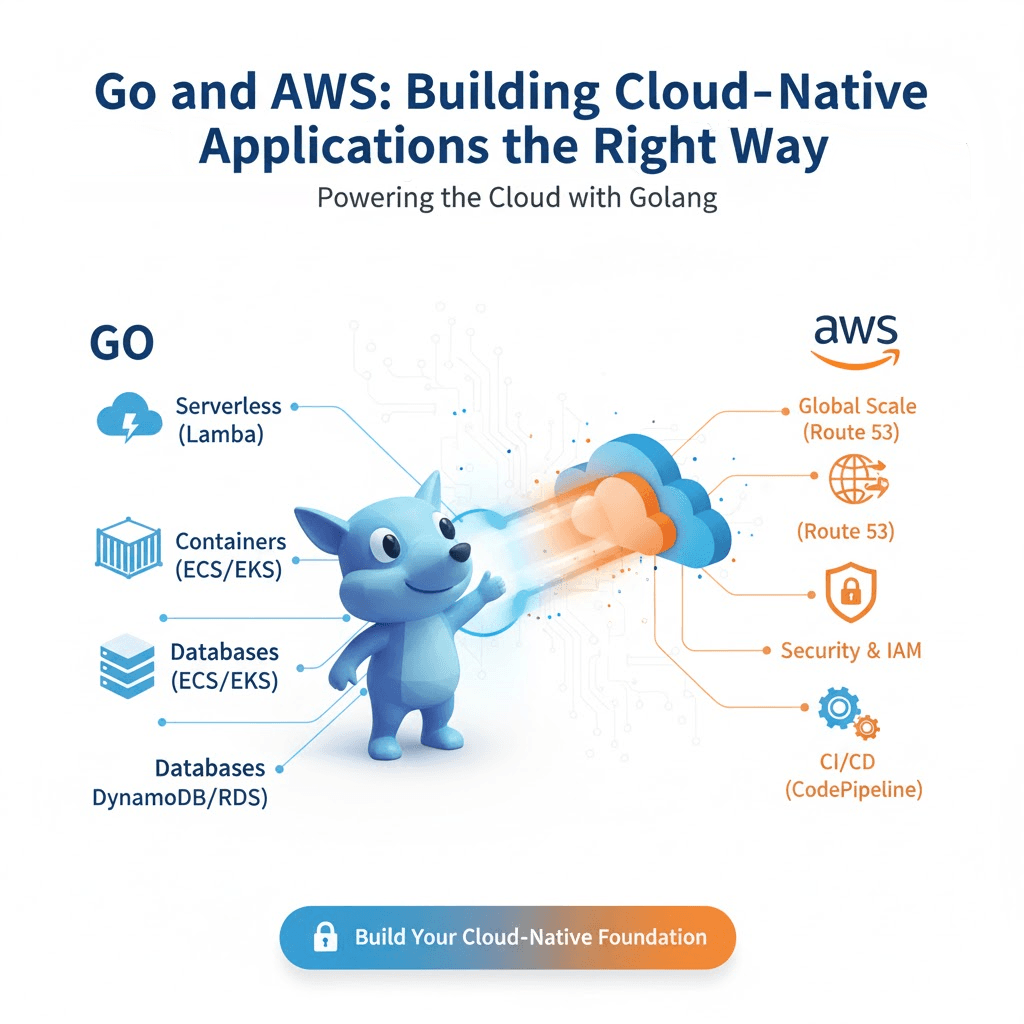
Go and AWS: Building Cloud-Native Applications the Right Way
In the modern cloud era, Go (Golang) has become one of the most trusted languages for building high-performance, scalable, and cloud-native applications. Combine it with Amazon Web Services (AWS) and you get a powerful duo capable of delivering everything from microservices and APIs to serverless applications and distributed systems.
In this article, we’ll explore why Go and AWS work so well together, what design patterns they enable, and how to build and scale production-grade cloud systems using both.
Why Go Is a Natural Fit for AWS
Let’s start with why Go has become the go-to language for cloud platforms including AWS itself.
AWS services like Amazon EC2, ECS, EKS, Lambda, and CloudWatch agents internally rely heavily on Go. Many AWS SDKs and CLIs are written in Go, including AWS CLI v2, AWS CDK for Go, and AWS Lambda Go runtime.
Here’s why:
| Feature | Why It Matters in AWS Cloud |
|---|---|
| Lightweight binaries | Deploy Go apps as single executables ideal for containers and Lambdas. |
| Fast startup time | Crucial for scaling microservices and serverless functions. |
| Concurrency model | Goroutines handle thousands of requests efficiently on EC2 or ECS. |
| Strong networking support | Perfect for APIs, SDKs, and distributed systems. |
| Cross-compilation | Build once, deploy anywhere EC2, Lambda, Fargate, or even EKS. |
| Built-in observability | Easy to integrate with CloudWatch, X-Ray, and Prometheus. |
Architecture Patterns: Go + AWS
Go complements AWS’s cloud services perfectly. Let’s look at some popular architectures where Go shines.
1. Microservices on ECS or EKS
Go’s minimal runtime overhead makes it perfect for containerized microservices. You can run your Go services on:
Amazon ECS (Fargate) for serverless container execution.
Amazon EKS (Kubernetes) for container orchestration.
A typical setup:
Go REST API → Docker → ECS/EKS → ALB → CloudWatch + X-Ray
Each microservice can be a small Go binary:
Exposes REST/gRPC endpoints.
Connects to DynamoDB, S3, or RDS.
Publishes events to SNS or SQS.
Emits metrics to CloudWatch.
Why it works well: Go’s small memory footprint means you can run more containers per node, reducing cost and improving scalability.
2. Serverless APIs with AWS Lambda
AWS Lambda supports Go as a native runtime, allowing you to build low-latency, event-driven services.
Example: Minimal REST API with Go Lambda
package main import ( \"fmt\" \"net/http\" \"github.com/aws/aws-lambda-go/events\" \"github.com/aws/aws-lambda-go/lambda\" ) func handler(req events.APIGatewayProxyRequest) (events.APIGatewayProxyResponse, error) { return events.APIGatewayProxyResponse{ StatusCode: http.StatusOK, Body: fmt.Sprintf(\"Hello from Go Lambda, %s!\", req.QueryStringParameters[\"name\"]), }, nil } func main() { lambda.Start(handler) }
You can deploy this Lambda behind API Gateway for a fully managed API no servers, no scaling headaches.
Best for: lightweight APIs, webhooks, or background jobs.
3. Event-Driven Systems
Go’s concurrency model makes it ideal for event-driven systems built on:
Amazon SQS (message queues)
Amazon SNS (pub/sub notifications)
Amazon Kinesis (data streams)
AWS EventBridge (event routing)
You can spin up a Go-based consumer that processes thousands of messages per second.
Example: SQS Consumer in Go
svc := sqs.New(session.Must(session.NewSession())) for { msgs, _ := svc.ReceiveMessage(&sqs.ReceiveMessageInput{ QueueUrl: aws.String(queueURL), MaxNumberOfMessages: aws.Int64(10), WaitTimeSeconds: aws.Int64(5), }) for _, msg := range msgs.Messages { go processMessage(*msg.Body) // Parallel processing } }
Why it works: Go’s goroutines make it effortless to scale concurrent message handling without external worker libraries.
4. Data Pipelines and Background Jobs
Go is widely used in building data ingestion pipelines and ETL jobs that run on:
AWS Batch
AWS Step Functions
AWS Lambda
Amazon EMR on EKS
For example:
S3 Upload → SQS → Go Worker on ECS → DynamoDB
Each stage can be a separate Go microservice communicating through events.
Go’s standard library provides:
encoding/jsonfor structured data handling.net/httpfor calling APIs.syncfor concurrency control.
5. Infrastructure as Code with Go (Pulumi / CDK)
AWS now supports Go as a first-class language in AWS CDK (Cloud Development Kit) and Pulumi, allowing developers to write infrastructure code in Go instead of YAML or JSON.
Example: Defining an S3 Bucket in Go (AWS CDK)
package main import ( cdk \"github.com/aws/aws-cdk-go/awscdk/v2\" \"github.com/aws/aws-cdk-go/awscdk/v2/awss3\" ) func main() { app := cdk.NewApp(nil) stack := cdk.NewStack(app, \"GoCDKStack\", &cdk.StackProps{}) awss3.NewBucket(stack, \"MyBucket\", &awss3.BucketProps{ Versioned: jsii.Bool(true), }) app.Synth(nil) }
Why it’s awesome:
Use the same language (Go) for both app and infra code.
Eliminate JSON/YAML complexity.
Deploy via
cdk deploy.
AWS Services Commonly Used with Go
Here’s a quick reference of Go-compatible AWS services and libraries:
| Service | Go SDK | Typical Use |
|---|---|---|
| Amazon S3 | github.com/aws/aws-sdk-go/service/s3 | File storage, static assets |
| Amazon DynamoDB | github.com/aws/aws-sdk-go/service/dynamodb | NoSQL data store |
| Amazon SNS/SQS | github.com/aws/aws-sdk-go/service/sqs | Messaging and event queues |
| AWS Lambda | github.com/aws/aws-lambda-go | Serverless functions |
| Amazon ECS/EKS | Docker + Go binaries | Containerized microservices |
| AWS CloudWatch | github.com/aws/aws-sdk-go/service/cloudwatch | Logging and monitoring |
| AWS CDK (Go) | github.com/aws/aws-cdk-go/awscdk | Infrastructure as code |
Security and IAM Best Practices for Go on AWS
When building Go applications on AWS, security must be top of mind.
Use IAM Roles, Not Keys
Never hardcode credentials.
Use IAM roles for EC2/ECS/Lambda to grant least privilege.
Environment Variables for Secrets
dbPassword := os.Getenv(\"DB_PASSWORD\")Store secrets in AWS Secrets Manager or SSM Parameter Store.
Enable Logging and Metrics
Send logs to CloudWatch Logs.
Expose custom metrics with the CloudWatch SDK.
Use Context and Timeouts
ctx, cancel := context.WithTimeout(context.Background(), 3*time.Second) defer cancel()This ensures API calls fail fast and don’t hang indefinitely.
Monitor with AWS X-Ray
Use thexrayGo SDK to trace requests end-to-end across microservices.
Deployment Options for Go Apps on AWS
| Platform | Description | Ideal For |
|---|---|---|
| Lambda (Go runtime) | Serverless execution, pay-per-use | APIs, automation, event triggers |
| ECS Fargate | Containerized microservices without managing servers | Production microservices |
| EKS | Kubernetes-managed Go workloads | Large-scale systems |
| EC2 | Full VM control | Long-running, custom workloads |
| Cloud Run (via ECR) | Deploy Go containers serverlessly | Lightweight services |
| Elastic Beanstalk | Easy PaaS for Go web apps | Rapid deployment |
Example ECS task definition:
FROM golang:1.22 AS builder WORKDIR /app COPY . . RUN go build -o server . FROM alpine:3.18 COPY --from=builder /app/server /server CMD [\"/server\"]
Observability: Logging, Metrics, and Tracing
Go apps integrate seamlessly with AWS observability tools.
CloudWatch Logs send logs using the standard Go logger.
CloudWatch Metrics publish custom metrics:
svc.PutMetricData(&cloudwatch.PutMetricDataInput{ MetricData: []*cloudwatch.MetricDatum{ { MetricName: aws.String(\"RequestDuration\"), Unit: aws.String(\"Milliseconds\"), Value: aws.Float64(125.4), }, }, Namespace: aws.String(\"MyApp\"), })
AWS X-Ray trace distributed transactions to detect latency bottlenecks.
Example Use Case: Go Microservice on AWS ECS
Here’s a realistic setup:
[Client] → [API Gateway] → [Go REST API on ECS Fargate] → [DynamoDB + S3] ↓ [CloudWatch Logs + X-Ray]
The Go app handles API requests.Stores data in DynamoDB and files in S3.
Automatically scales via ECS Fargate.
Observability handled via CloudWatch.
This architecture scales automatically, keeps costs predictable, and provides high availability with minimal ops overhead.
Developer Tips for Go on AWS
Use AWS SDK v2 for Go (faster and more modular).
Use context.Context everywhere for cancellation and timeouts.
Wrap all AWS calls with retry logic using exponential backoff.
Use structured logging (
logrus,zap) for CloudWatch compatibility.Build multi-stage Docker images to keep containers small.
Use Go’s testing tools (
go test,mockgen) for AWS SDK mocks.
Lastly..
AWS and Go are a perfect match for cloud-native engineering:
AWS gives you the infrastructure foundation.
Go gives you the performance, simplicity, and reliability to run it efficiently.
Whether you’re building:
Serverless Lambda functions,
Microservices on ECS/EKS,
Event-driven data pipelines, or
Infrastructure-as-code with CDK/Pulumi,
Go enables you to write production-grade, efficient, and scalable cloud applications all with minimal friction.